
A Message From Sensei
日本の伝統文化には、茶道、華道等ありますが、剣道・居合道もそのひとつです。 それぞれ形は違いますが、すべてそれらの中には日本人の「美意識ー侘び寂び」が含まれていると思います。 そして美しい礼法や所作には無駄がなく、それが見る人に感動を与えるものとなります。
志道学院NY士道館は、剣道には「美」が必要であると考え(つまりこれは基本に従った正しい武道に他なりません)、そしてその結果として強く正しく美しい剣道が生まれる、と考えています。 また、居合道は、起源は室町時代にあり、応仁の乱の際にいつでも武器を抜ける様にしていたというのが『居合』の始まりでした。 その後戦国時代に入ると、林崎重信がこの『居合』を『居合道』という武道として確立させました。そして武士のたしなみとして修練される様になったのです。 日本刀の操作法に由来がある居合道は、勝負を抜刀の一瞬にかけるため、修行は『死生一妙』『動静一貫』を目指す心身鍛錬の道です。 しかし、剣の理法の習得が『人間形成の道』という考え方においては剣を払う事を主とする武道としての剣道と同じで『剣居一体』の武道です。
その日本伝統文化剣道・居合道をこの異国の地に正しく広める事を目的とし、志道学院は後数年で45年間という年月を、ニューヨーク州に公認いただいた日本文化非営利団体法人として、東海岸を中心に躍進していくつかの系列道場を持つに至りました。その宗家道場であるNY士道館は、私の恩師の故中西康先生(剣道範士9段、居合道範士8段、杖道範士8段)の広島士道館の道場名を先生が亡くなられた後、先生の奥様よりいただきNY士道館として現在活動をしております。
NY士道館の稽古は、剣道の場合、マンハッタン道場、プレザントビル道場の2か所で行い、それぞれマンハッタン道場は木、土、プレザントビル道場は火、土、日が稽古日です。また、居合道はプレザントビル道場で日曜日の午後に稽古しています。生徒はいずれの道場に何回でも自由に通うことができ、基本的に館長および師範の私、加藤彰三(剣道教士八段、居合道教士七段)が直接指導を行います。また、経験豊富な高段者(6,7段)の先生方が補佐として指導にあたります。剣道及び居合道の稽古日は異なりますが同じ指導内容です。
稽古は、子供(5歳~18歳)、初心者、経験者、そして経験者だが長くブランクのある方等それぞれが無理なく自分のペースで続けられるように指導が行われます。大人の生徒には、少年時からずっと剣道を続けている人、20年以上のブランクがあり再開した人、高齢になってから剣道を始めた人、企業の駐在員で忙しい時間の合間を縫って稽古をする人等様々な境遇の人がいます。
剣道も居合道も、歳をとっても若者や少年と一緒に稽古ができ、一生続けられる武道(生涯剣道)であると言っても過言ではありません。子供達には時には厳しく指導させていただくこともありますが、剣道・居合道が単に体を動かす運動ではなく、稽古を通じて人間形成を目指し、社会に貢献する人間に成長してもらいたい、という気持ちを込めて指導に当たらせていただいています。
皆さんと一緒に稽古ができる日を心よりお待ち申し上げております。
加藤彰三
館長および師範
志道学院ニューヨーク士道館
Kendo and Iaido are among Japan’s traditional cultural arts, along with the tea ceremony and flower arrangement (ikebana).
While their forms differ, they all embody the Japanese aesthetic concept of wabi-sabi, an appreciation of simplicity, elegance, and impermanence. Beautiful etiquette and refined movements are free from unnecessary excess, and their elegance leaves a lasting impression on those who observe them.
At Shidogakuin NY Shidokan, we believe that true kendo requires beauty, which is achieved through faithful adherence to proper fundamentals and authentic martial principles. Through such practice, strong, correct, and beautiful kendo naturally emerges.
The origins of Iaido can be traced back to the Muromachi Period. During the Onin War, warriors needed to be prepared to draw their swords at any moment, and this gave rise to the concept of iai. Later, during the Warring States Period, Shigenobu Hayashizaki systematized these techniques into the martial art now known as Iaido.
Because Iaido is derived from the practical use of the Japanese sword, practitioners strive to perfect techniques in which victory is determined in the instant of drawing the blade. Training therefore becomes a path of mental and physical discipline, seeking the ideals of “life and death existing as one” and “unity of movement and stillness.”
In the same way that kendo emphasizes character development through mastery of the principles of the sword, Iaido also serves as a path of personal cultivation. For this reason, kendo and iaido are often regarded as two expressions of the same martial spirit.
With the goal of promoting the traditional Japanese arts of Kendo and Iaido in the United States, Shidogakuin has served the East Coast community for nearly 45 years as a New York State-recognized non-profit Japanese cultural organization, and has grown to establish several affiliated dojos across the Eastern United States.
The headquarters dojo, NY Shidokan, carries on the name of Hiroshima Shidokan, the dojo of the late Yasushi Nakanishi Sensei (Kendo Hanshi 9th Dan, Iaido Hanshi 8th Dan, Jodo Hanshi 8th Dan). Following his passing, the name “Shidokan” was graciously entrusted to me by Mrs. Nakanishi.
NY Shidokan kendo classes are held at two locations: Manhattan Dojo and Pleasantville Dojo. Training sessions are conducted on Thursdays and Saturdays in Manhattan, and on Tuesdays and Saturdays and Sundays in Pleasantville. Iaido classes are held at Pleasantville Dojo on Sunday afternoons. Students are free to attend either dojo as often as they wish.
Instruction is provided directly by me, Shozo Kato (Kendo Kyoshi 8th Dan, Iaido Kyoshi 7th Dan). Instruction is also supported by experienced 6th- and 7th-dan instructors.
Although kendo and iaido are practiced on different days, the same teaching philosophy and standards are maintained in both disciplines.
Classes are structured so that children (ages 5–18), beginners, experienced practitioners, and those returning after a long absence can all progress comfortably at their own pace.
Our adult students come from a wide variety of backgrounds. Some have trained continuously since childhood, while others have returned after an absence of more than twenty years. Some began practicing later in life, and others are Japanese expatriates balancing training with demanding professional careers.
It is no exaggeration to say that both Kendo and Iaido are lifelong martial arts (often referred to as “lifelong kendo”). Practitioners of all ages can train together, and many continue their practice throughout their entire lives. While children may occasionally receive strict instruction, our goal is never merely physical exercise. Through training, we strive to cultivate character, discipline, respect, and the ability to contribute positively to society.
We sincerely look forward to the opportunity to train with you.
Shozo Kato
Head Instructor
Shidogakuin NY Shidokan
週間ニューヨーク生活 2026年9月24日掲載
剣道のN Y士道館に在外公館長表彰
文化継承と日米友好に貢献
第36回グレーターノースイースタン米国剣道連盟(GNEUSKF)剣道大会が9月20日、ニューヨーク州パーチェスの慶應義塾ニューヨーク学院で開催され、17の道場および大学・高校の剣道クラブから130人を超える剣士が参加した。
大会には、在ニューヨーク日本国総領事の片平聡大使が来賓として出席し、開会式で挨拶した。あわせて、グレーターノースイースタン米国剣道連盟の中心道場である志道学院ニューヨーク士道館(加藤彰三館長)に対し、長年にわたる活動を称え在外公館長表彰が行われた。
表彰状では、同道場が1982年の創設以来長年にわたり剣道・居合道の普及と次世代の人材育成に尽力するとともに、日本文化の普及促進や大会運営等を通じて日米両国民の相互理解や友好関係の促進にも大きな役割を果たしてきたことが高く評価された。
また今大会には、日本から警視庁前主席師範の梯正治・範士八段と、警視庁前師範で東京武道館師範の石井猛・範士八段が来米し、それぞれ審判長、副審判長を務めた。両氏は長年にわたり日本剣道界の第一線で活躍してきた指導者であり、その指導と助言は参加者にとって大きな励みとなったようだ。
会場では、真剣勝負の中にも礼節を重んじる武道精神が随所に見られ、試合後には所属道場の枠を超えて互いの健闘を称え合う姿が見られた。長年にわたり北東部地域で育まれてきた剣道を通じた交流と友情、そして日本文化の継承を象徴する一日となった。
表彰を受けたNY士道館の加藤館長は「このたび、このような名誉ある表彰を賜り、身に余る光栄です。剣道を始めて60年、ニューヨークに道場を開いて40年以上、多くの先生方、仲間、門下生、そして支えてくださった皆様のお力があって今日があります。この表彰は私個人ではなく、皆様と共に頂いたものと受け止めています。心より感謝するとともに、これからも剣道を通じて日本文化とその精神を次の世代へ伝えていきたいと思います」と喜びを語った。
大会戦績結果は次の通り
大会では少年から高段者まで幅広い年代の剣士が熱戦を展開した。
個人戦(少年・学生)
| 9歳以下の部 | Ryan Sohn(GSK) |
| 10〜12歳の部 | Tomohide Sato(志道学院ニューヨーク士道館) |
| 13〜15歳の部 | Akihiro Yonekawa(Cherry Hill Kenyukai) |
| 女子13〜18歳の部 | Suzuha Winters(NY Kenshinkai) |
| 高校・大学生の部 | Lucas Jeong(Chung Pa Kendo Dojo) |
個人戦(一般)
| 女子の部 | Eri Kosakaya(Brooklyn Kenyukai) |
| シニアの部 | Shinichiro Fukui(NY Kenshinkai) |
| 初段以下の部 | Suho Lee(Chung Pa Kendo Dojo) |
| 二段から四段の部 | Kyoyuki Shiono(Brooklyn Kenyukai) |
| 五段以上の部 | Kei Takahashi(GSK) |
団体戦
| 16歳以下三人制の部 | Cherry Hill Kenyukai |
| 一般五人制の部 | 志道学院ニューヨーク士道館Aチーム(Shidokan A) |
Weekly NY Seikatsu — September 24, 2026 Published
NY Shidokan Kendo Dojo Receives Consul General’s Commendation
Recognized for Contributions to Cultural Heritage and U.S.-Japan Friendship
The 36th Greater Northeast U.S. Kendo Federation (GNEUSKF) Kendo Tournament was held on September 20 at Keio Academy of New York in Purchase, New York. More than 130 competitors representing 17 dojos, universities, and high school kendo clubs took part in the event.
Ambassador Satoshi Katahira, Consul General of Japan in New York, attended the tournament as an honored guest and delivered remarks at the opening ceremony. During the ceremony, Shidogakuin New York Shidokan, led by Chief Instructor Shozo Kato and serving as a central dojo of the Greater Northeast U.S. Kendo Federation, received the Consul General’s Commendation in recognition of its many years of distinguished service.
The commendation recognized the dojo’s longstanding efforts since its establishment in 1982 to promote kendo and iaido, cultivate future generations of practitioners, and introduce Japanese culture to the wider community. It also praised the dojo’s significant role in promoting mutual understanding and friendship between the people of Japan and the United States through tournaments, cultural activities, and other programs.
The tournament also welcomed two distinguished instructors from Japan: Masaharu Kakehashi, Kendo Hanshi 8th Dan and former Chief Kendo Instructor of the Tokyo Metropolitan Police Department, and Takeshi Ishii, Kendo Hanshi 8th Dan, former instructor of the Tokyo Metropolitan Police Department and current instructor at the Tokyo Budokan. They served respectively as Chief Referee and Deputy Chief Referee.
Both instructors have long been active at the highest levels of Japanese kendo, and their guidance and advice provided great encouragement and inspiration to the participants.
Throughout the tournament, the spirit of budo was evident not only in the intensity of the matches, but also in the emphasis on courtesy and respect. After competing, participants could be seen congratulating one another across dojo affiliations. The event became a fitting symbol of the friendship,交流, and preservation of Japanese culture that have been fostered through kendo in the northeastern United States over many years.
Commenting on the commendation, Shozo Kato, Chief Instructor of New York Shidokan, said:
“I am deeply honored and humbled to receive such a prestigious commendation. I have practiced kendo for 60 years and have operated a dojo in New York for more than 40 years. I would not be where I am today without the support of so many teachers, fellow practitioners, students, and all those who have supported us over the years.
I regard this commendation not as something I have received personally, but as an honor shared with everyone who has walked this path with us. I am sincerely grateful, and I hope to continue passing Japanese culture and its spirit on to future generations through kendo.”
Tournament results
Competitors ranging from young children to senior high-ranking practitioners demonstrated spirited kendo throughout the tournament.
Individual champions (youth and students)
| 9 & Under | Ryan Sohn (GSK) |
| Ages 10–12 | Tomohide Sato (Shidogakuin New York Shidokan) |
| Ages 13–15 | Akihiro Yonekawa (Cherry Hill Kenyukai) |
| Girls Ages 13–18 | Suzuha Winters (NY Kenshinkai) |
| High School & College Division | Lucas Jeong (Chung Pa Kendo Dojo) |
Individual champions (adults)
| Women’s Division | Eri Kosakaya (Brooklyn Kenyukai) |
| Senior Division | Shinichiro Fukui (NY Kenshinkai) |
| Shodan & Below Division | Suho Lee (Chung Pa Kendo Dojo) |
| 2nd–4th Dan Division | Kyoyuki Shiono (Brooklyn Kenyukai) |
| 5th Dan & Above Division | Kei Takahashi (GSK) |
Team champions
| Under-16 three-person team | Cherry Hill Kenyukai |
| Adult five-person team | Shidogakuin New York Shidokan A Team (Shidokan A) |
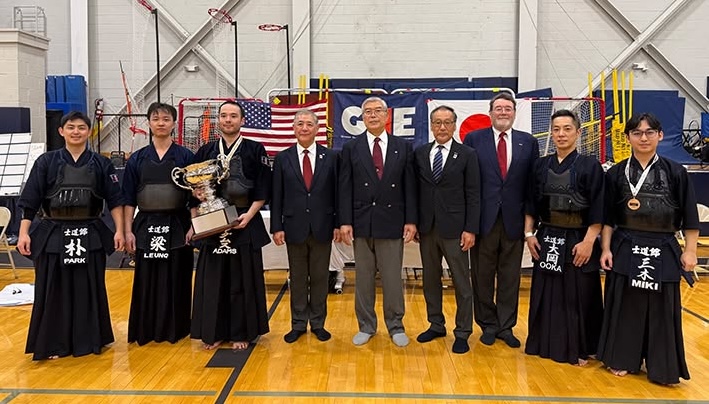
優勝選手と大会役員。中央背広姿左から石井猛・剣道8段範士・元警視庁師範、梯正治・剣道8段範士・元警視庁主席師範、加藤彰三・剣道8段教士・グレーター米国北東部剣道連盟会長(GNEUSKF) 志道学院NY士道舘館長、ルー・マーフィー GNEUSKF副会長兼大会会長
Tournament champions and officials. From left at center: Takeshi Ishii, Kendo Hanshi 8th Dan and former instructor of the Tokyo Metropolitan Police Department; Masaharu Kakehashi, Kendo Hanshi 8th Dan and former Chief Kendo Instructor of the Tokyo Metropolitan Police Department; Shozo Kato, Kendo Kyoshi 8th Dan, President of the Greater Northeast U.S. Kendo Federation (GNEUSKF) and Chief Instructor of Shidogakuin New York Shidokan; and Lewis Murphy, GNEUSKF Vice President and Tournament Chairman.
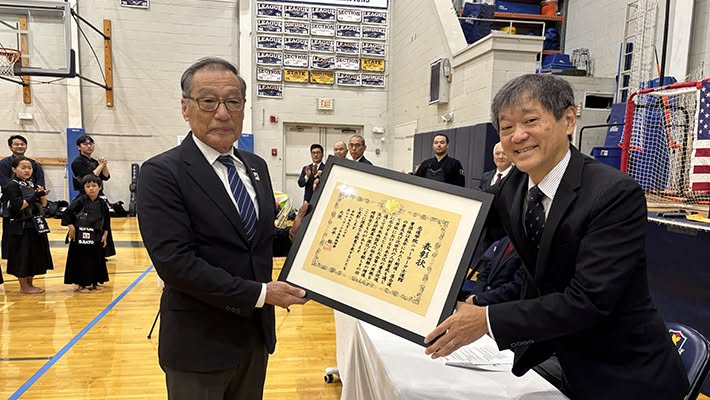
片平大使(右)から在外公館長表彰を受ける加藤館長
Shozo Kato-sensei receiving the Consul General’s Commendation from Ambassador Katahira.
From the Words Attributed to Oda Nobunaga
Reflections on the Kendo I Strive For
As I read through words and sayings commonly attributed to Oda Nobunaga, I am often struck by how closely many of their underlying ideas reflect what I have come to value through many years of practicing and teaching Kendo.
Not all of these sayings can be historically verified as Nobunaga’s own words. For me, however, their value lies not simply in who may have said them, but in what they can teach us when we reflect upon them through the practice of Kendo.
The following are my own interpretations—lessons that express the kind of Kendo I continue to seek.
“It also takes courage to step back.”
In Kendo, courage does not always mean moving forward.
There are times when we must resist the temptation to strike, adjust the distance, and begin our seme again.
But there is an important difference between stepping back and escaping.
The body may move backward, but the spirit must never retreat.
Even while creating distance, we maintain our connection with the opponent and prepare for the next opportunity.
That, too, is courage in Kendo.
“There are no absolutes.”
There is no point in Kendo at which we can say, “Now I have completed it.”
Something we were able to do yesterday may not work today. Something we could not understand when we were young may suddenly become clear after decades of training.
We should never allow our Kendo to become fixed.
We must continue questioning, changing, and learning.
The higher our rank becomes, the more willing we should be to return to the fundamentals.
“Be sensitive to the right moment.”
Of all these ideas, this is one that I consider especially important in Kendo.
Kendo is not simply a competition to see who can strike faster.
We apply pressure. We observe. We feel the opponent.
There is a moment when the opponent’s mind moves, when the kamae begins to break, when the opponent is about to strike, or when the opponent begins to retreat.
We must learn to recognize that moment—the ki, the opportunity.
Do not simply strike fast. Strike when the moment is right.
This is one of the ideals of Kendo that I continue to pursue.
“Have an ideal, and live by your convictions.”
We should have an ideal in our Kendo.
Winning alone should not be our purpose.
We should ask ourselves:
What kind of Kendo do I want to practice?
What kind of kendoka do I want to become?
We begin by learning from our teachers. Through mitori-geiko, we observe their Kendo and try to follow it.
But eventually, we must discover our own Kendo.
Do not merely imitate your teacher’s technique. Seek to understand the riai—the principles behind it.
To me, that is how a teacher’s Kendo is truly inherited.
“The greatest victory is to win without fighting.”
When we are young, we often try to win by striking faster.
As our Kendo develops, however, we begin to understand the importance of what happens before the strike.
Take the center. Apply pressure with the spirit. Create uncertainty. Cause the opponent to move.
By the time the opponent reacts, the decisive moment may already have been created.
My goal is to progress:
from striking in order to win,
to winning through seme and then striking.
And beyond that lies an even deeper ideal—the ability to control the encounter without needing to strike.
“Do not think it impossible. There is always a way.”
As we grow older, we cannot move exactly as we did when we were young.
But that should never become an excuse for our Kendo to stop developing.
When we lose speed, we can deepen our understanding of maai.
When physical strength diminishes, we can seek greater sae and riai.
When we can no longer rely on moving ourselves faster, we can learn how to move the opponent.
As the body changes, our Kendo should also change.
This is one reason Kendo can remain a lifelong pursuit.
“Everything begins and ends with preparation.”
An ippon is not created only at the instant the shinai reaches its target.
It comes from everything that has preceded it—daily kihon, proper appearance, reiho, care of our equipment, physical preparation, and our state of mind.
And when keiko ends, we reflect upon what happened.
That reflection becomes preparation for the next keiko.
Practice begins before we enter the dojo and continues after we leave it.
“One who has never known defeat may ultimately destroy himself.”
There is no shame in losing.
Defeat shows us what we still lack and what we still need to learn.
The greater danger comes when our rank becomes higher, people begin calling us “Sensei,” and we start believing that we already understand.
At that point, fewer people may correct us.
That makes self-reflection even more important.
When others no longer teach us, we must learn how to teach ourselves.
The higher our rank, the more humble we should become, and the more seriously we should remain students of Kendo.
“Follow your path. Do not be distracted by others.”
We do not need to compare our Kendo constantly with that of others.
Our bodies, ages, personalities, and experiences are different.
We should learn from our teachers, from our seniors, from our peers—and sometimes from our juniors and students.
But ultimately, each of us must walk our own path.
The goal is not simply to become better than someone else.
It is to become better than the person we were yesterday.
That continuous effort is shugyo.
“Work is something you must discover and create for yourself.”
The same is true of keiko.
We cannot improve simply by waiting for a teacher to tell us what to do.
We should constantly ask ourselves:
What can I learn today?
Why was I struck?
Why did my technique fail?
What can I learn from this opponent?
A serious student learns to discover his or her own problems.
Good keiko is not something a teacher simply gives us. We must also learn to create it ourselves.
“Do it or do not do it. That is all.”
In Kendo, if we wait until the opportunity appears and then begin thinking about whether to strike, the opportunity is already gone.
We apply seme.
The opponent breaks.
The moment comes.
Then there can be no hesitation.
Be patient and deliberate in creating the opportunity.
When the moment comes, commit completely.
This is what I understand by Sutemi does not mean attacking recklessly. It means that after sufficient seme and after recognizing the true opportunity, we abandon hesitation and give ourselves completely to the strike.
“Only by living wholeheartedly does one’s life truly shine.”
When we are young, we may pursue victory.
Later, we may pursue rank.
But if we continue practicing for many years, the meaning of Kendo gradually changes.
There is a time when we practice primarily for ourselves.
Then comes a time when we have a responsibility to teach and develop others.
And perhaps eventually, there comes a time when younger generations can learn something simply by watching how we practice, how we conduct ourselves, and how we continue our own shugyo.
Kendo is not only about taking ippon.
It is also about how we train, how we face others, how we face ourselves, and ultimately how we live.
That, to me, is Kendo.
A Lifelong Mitori-Geiko
I do not believe there is a final point of completion in Kendo.
When we are young, we learn through our bodies.
With experience, we begin to understand riai.
When we become instructors, we discover that we can learn from the very people we teach.
We learn by watching our teachers.
We learn from our fellow kendoka.
We learn from our students.
And we learn from the person we ourselves were yesterday.
Rank does not change the fact that we remain students of the Way.
Teaching does not end our own shugyo.
The teacher is also a student.
And perhaps this is one of the most important lessons Kendo has given me:
Kendo is a lifelong practice of 見取り稽古 — mitori-geiko.
Our History
Originally founded in 1984, for over 30 years, our dojo has been practicing the arts of Kendo and Iaido under the instruction of Kato-sensei
Kendo
In Japanese, the word kendo literally translated means "way of the sword" ("ken" = sword, and "do" = the way). It is the traditional Japanese art of full-contact fencing developed by the Samurai.
Iaido
Iaido is the martial art of drawing and cutting with a katana - either an unsharpened practice blade or the real thing. In iaido, a practitioner executes set forms, or kata, against an imaginary opponent.